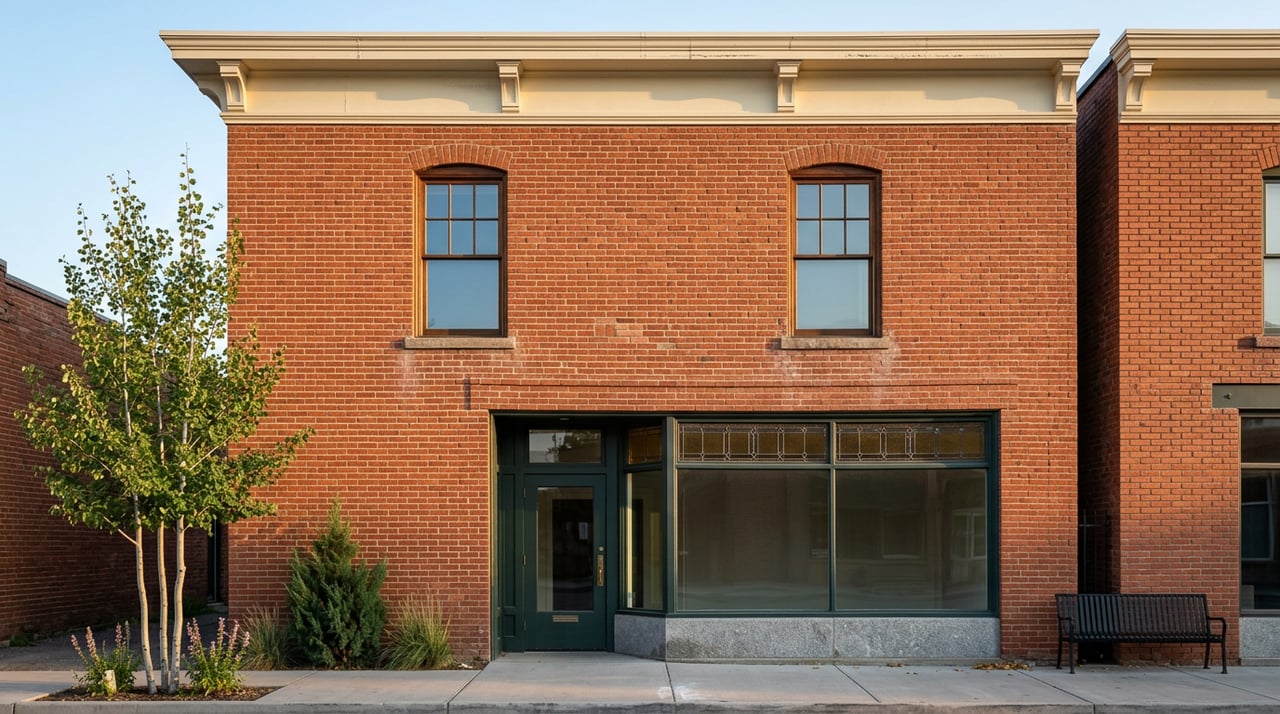
Walk east on Bennett Avenue past the glass tower of Chamonix Casino Hotel, past the string of blackjack tables glowing through the windows, and you hit a stretch of brick storefronts that have sat quiet for years. Same street, same Victorian facades, two very different economic realities standing shoulder to shoulder. That gap is the real story in Cripple Creek right now, and it's bigger than any single restaurant opening or festival weekend.
For more than three decades, casino revenue has been the thing keeping this town's 1890s brick buildings standing. It's also the reason a city of roughly 1,100 people has an economy built almost entirely around gaming. Now Cripple Creek is trying something the casino money never quite managed on its own: filling in everything else.
The buildings casinos were supposed to save
Cripple Creek's brick core exists because of fire, not planning. In April 1896, two blazes four days apart burned through roughly a third of the downtown business district, and the town rebuilt in brick and stone rather than the wood that had fed the flames. That rebuild is what still lines Bennett Avenue today, and it's part of what earned the district National Historic Landmark status in 1961.
Mining kept the town alive for decades after that, then didn't. By the late 1980s the population had shrunk and the historic core was at real risk. In 1990, Colorado voters approved an amendment allowing Cripple Creek to build casinos, and the town leaned on casino revenue to fund preservation. It worked, in the sense that the buildings are still there. It also, as the Colorado Encyclopedia puts it, transformed the town the casinos were supposed to help preserve. Gaming became the anchor tenant of Bennett Avenue, and the businesses that used to fill the space between anchors, the shops, the non-casino restaurants, the everyday retail, never fully came back.
Amanda Benson, the city's new Main Street coordinator, said as much when Cripple Creek picked up its latest designation this year. She described a city with "such a focused economy" and pointed to a detail that doesn't show up in the tourism brochures: some of the casinos operate out of historic buildings, but others remain empty. Thirty-six years of gaming revenue preserved the shells. It didn't guarantee they'd all stay occupied.
What the Main Street designation actually targets
In January 2026, the Colorado Department of Local Affairs named Cripple Creek an official Main Street Community, alongside Woodland Park, Fort Morgan, and the Town of Kiowa. The designation joins the two Teller County towns to Victor, which already held the status, making the county a full trifecta of DOLA-backed Main Streets.
The program isn't a marketing badge. Since 2019, Colorado's Main Street communities have drawn more than $218 million in public investment that catalyzed an additional $396 million in private investment statewide, according to DOLA's own accounting, resulting in 620 net new businesses and nearly 1,000 facade improvements. Meeker, a town of 3,000 south of Craig, is one of the program's clearer case studies: more than 20 jobs created, 10 new businesses opened, and $290,000 in private investment attracted, per the Meeker Chamber of Commerce. Cripple Creek is starting from zero on its own track record, but the mechanism is the same: mini-grants for facade work, technical assistance for property owners, and a formal structure for the kind of storefront-by-storefront rebuilding that casino tax revenue was never designed to fund.
Marie Rieger, the city's marketing and events director, framed the immediate priorities as practical rather than symbolic: better wayfinding and interpretive signage, and a pocket park next to city hall. Her caution is worth noting too. "You need people who understand how to build so it doesn't impede on any historic preservation," she told KOAA after the announcement. In a National Historic Landmark district, that's not a small consideration.
Brandie Larsen, who owns Broken Box Boutique on Bennett Avenue and whose husband is fifth generation from Cripple Creek, put the stakes in more personal terms. "We all work together. All the storefronts," she said, describing a town she's now raising the sixth generation in. That's the texture Main Street money is meant to protect: not the casino floors, but the family businesses working the blocks around them.
The dinner table just got a lot bigger
While the city was applying for Main Street status, private capital was already making its own bet on Cripple Creek. Chamonix Casino Hotel opened its casino floor in December 2023 with a temporary restaurant and buffet, celebrated a full grand opening in November 2024 with performances by Jay Leno and country artist Tenille Arts, and finished out its spa, fitness center, and rooftop pool by early 2025. At nine stories and 440,650 square feet, with 300 guest rooms and 52 VIP suites, it's the first property in town to offer what the design firm behind it calls Cripple Creek's first luxury guestrooms.
The dining lineup is where the shift is most visible for anyone who already lives here. Chamonix's marquee restaurant, 980 Prime, is run by chef Barry S. Dakake, who trained under James Beard Award winner Charlie Palmer and led N9NE Steakhouse before coming to Colorado. Alongside it sits Don Juan's Cocina for modern Mexican, a hidden speakeasy tucked inside the property, and Home Café next door at Bronco Billy's, which the property describes as where regulars become regulars.
That's a different kind of dining scene than the one longtime residents grew up with, though it hasn't replaced it. Here's how the two layers currently sit side by side on Bennett Avenue:
| Established spot | Setting | What it's known for |
|---|---|---|
| Maggie's Restaurant | Lower level, Colorado Grande Casino | Classic steaks, seafood, and burgers |
| Lombard's | Double Eagle Casino | Full soup and salad bar, breakfast through dinner |
| The Creek Restaurant | Historic brick building on Bennett Ave | Early 1900s ambiance, seasoned sirloins and ribeye |
| New arrival | ||
| 980 Prime | Chamonix Casino Hotel | Fine dining steakhouse, 40-day dry-aged ribeyes |
| Don Juan's Cocina | Chamonix Casino Hotel | Modern Mexican, shareable plates |
Neither layer is going away. The point is that Cripple Creek now has both a casino-diner tradition that's decades old and a genuine destination-dining option that didn't exist here before Chamonix opened.
Sixty thousand people, one weekend in February
Nothing captures the scale mismatch between Cripple Creek's population and its foot traffic like the Ice Festival. Held most winters on Bennett Avenue, the event was expected to bring 60,000 people to town this past February, in a city with roughly 1,100 residents. That's more than fifty visitors for every person who lives here, for one week, on one street.
The summer calendar carries its own long-running draws. Donkey Derby Days, held every June, marked its 95th year in 2026, and the free-roaming donkey herd that gives the festival its name is looked after year-round by the local nonprofit Two Mile High Club. The Teller County Fair ran from late July into early August this year, and the Salute to American Veterans Rally, which returned in 2025 after a five-year hiatus, is back again August 21 to 23. None of this is new by itself. What's new is that the town is now trying to convert that kind of foot traffic into something that sticks around past the weekend, rather than draining back out on Sunday night.
A town also rewriting its own rulebook
The Main Street push isn't happening in isolation. Over the past year, Cripple Creek voters approved forming a home rule charter committee, the first real step toward the city writing its own charter instead of operating under Colorado's statutory default. A nine-member group is now drafting that document, with a vote expected later in 2026. Home rule has historically made some elected leaders, business operators, and casino owners here nervous, but a series of 2025 town meetings on the topic apparently moved enough opinion to get the committee approved.
Put next to the Main Street designation, it reads less like two unrelated headlines and more like the same instinct showing up twice: a town built almost by accident around one industry, now building the civic tools to be something more deliberate.
What it looks like from the sidewalk
None of this means Bennett Avenue is unrecognizable. The brick still dates to 1896. The donkeys still wander. The casinos are still the biggest buildings on the block. But the storefronts around them are starting to get their own source of momentum, separate from gaming revenue, for the first time since 1990. That's the shift worth watching if you already call this town home: not a new restaurant here or a grant there, but a downtown quietly building a second economic leg to stand on.
If you're curious what any of this means for property here, whether you're weighing a move within Teller County or just want to know what a Bennett Avenue address is actually worth as the town changes, High Country Realty knows this market block by block. Get Your Home Valuation and we'll walk you through it.